Decoding your DNA in 4 Seamless Steps.
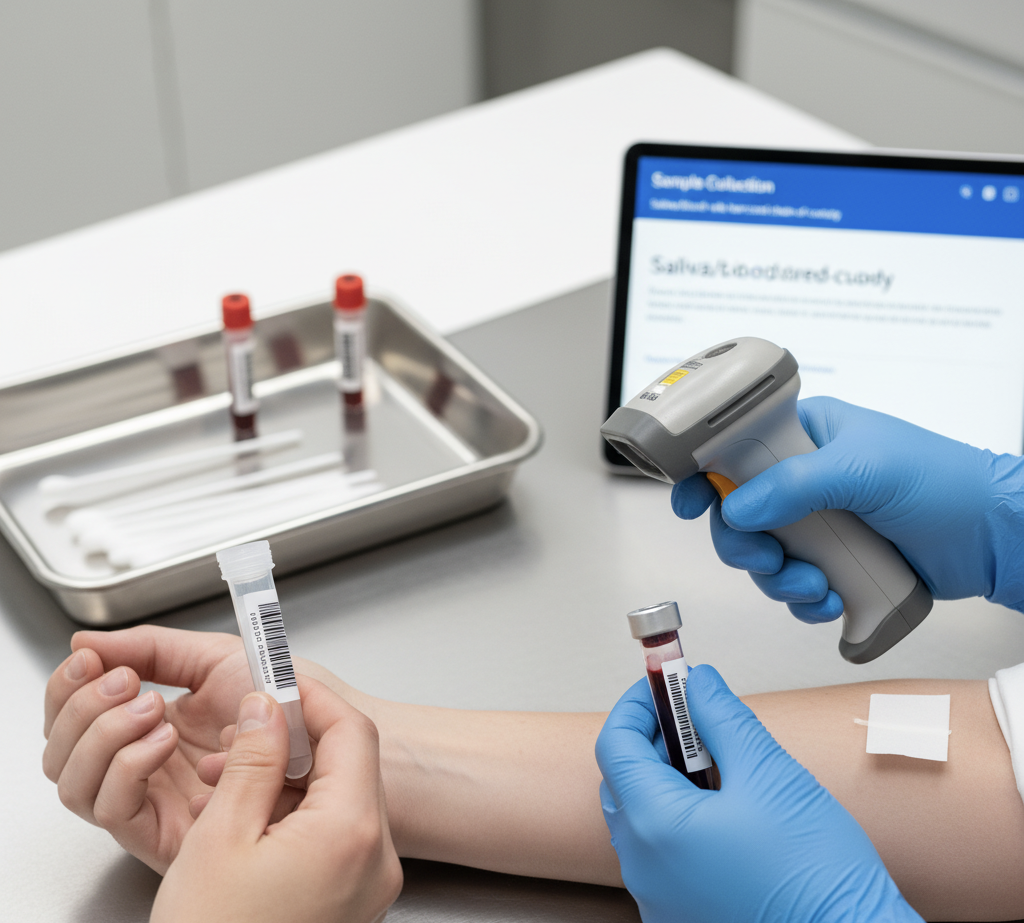
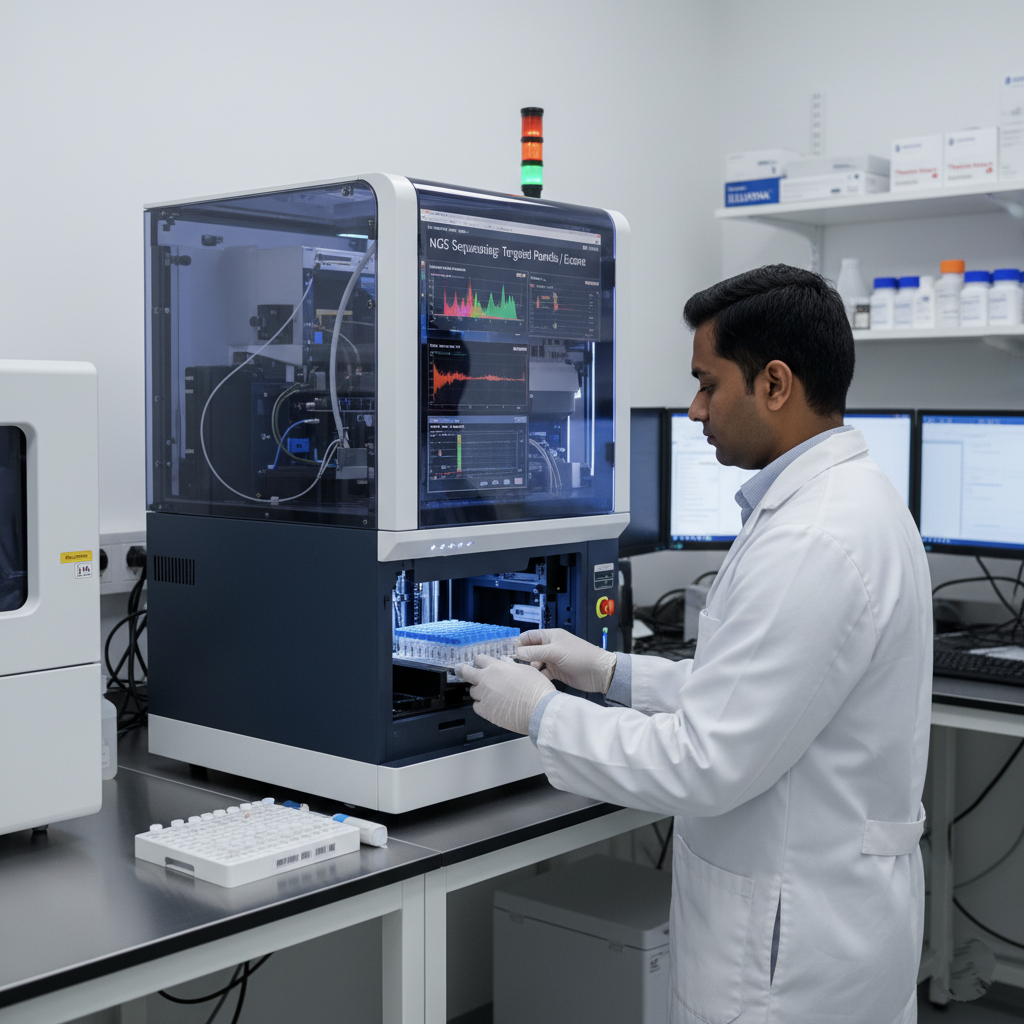
Sequencing means reading the exact order of the DNA letters (A, T, C, G) in your sample — just like reading a book, one word at a time.
QC = Quality Checks. It’s like a double-check system at every step to make sure the DNA reading is accurate, complete, and trustworthy before sending results to your doctor.
| Step | What Happens | Why It Matters |
|---|---|---|
| 1. DNA Preparation | Your sample arrives. DNA is extracted and broken into tiny pieces. | Clean DNA = accurate reading. |
| 2. Library Preparation | Tags (adapters) added so machines can read DNA. | Allows millions of pieces to be read at once. |
| 3. Target Capture | Magnetic beads grab only key genes (e.g., BRCA1, TP53). | Saves time — skips junk DNA. |
| 4. Sequencing | DNA flows in a flow cell. Camera reads colored lights (A=green, etc.). | Generates billions of 150-letter reads. |
| 5. QC Checks | Computers check clarity, balance, accuracy. | Catches errors early. |
| Metric | Target | What It Means |
|---|---|---|
| Uniformity | ≥90% | All genes read evenly — no missed spots. |
| On-Target Rate | ≥70% | Most reads are from intended genes. |
| Coverage Depth | 100x–1000x | Each letter read 100–1000 times. |
| Error Rate | <1 in 10,000 | Extremely low error chance. |
Example: If a gene has a mutation, we need to see it clearly and repeatedly — not just once by chance.
| Type | What It Covers | Best For |
|---|---|---|
| Targeted Gene Panel | 50–500 cancer genes | Fast, affordable, focused |
| Whole Exome | ~22,000 protein-coding genes | Broader screening |
| Hybrid-Capture / Amplicon | Two DNA capture methods | Both highly accurate |

Bioinformatics = Turning raw DNA data into meaningful health insights.
Think of it like this: Step 2 gave us billions of DNA “words” Step 3 reads them, finds spelling mistakes (mutations), and tells us what they mean for your health.
We use smart computers + expert scientists to do this accurately and fast.
Our BWA/GATK-class pipeline is the gold standard in clinical genomics — used by top labs worldwide. It’s automated but never fully automatic — every result is reviewed by a human expert.
| Step | What Happens | Why It Matters |
|---|---|---|
| 1. Align DNA Reads | Billions of short DNA pieces are lined up to the human genome map using BWA (like putting puzzle pieces in place). | Ensures we know exactly where each DNA letter belongs. |
| 2. Clean & Refine | Fix errors from the machine (e.g., duplicates, misreads) using GATK tools. | Removes noise so only real changes remain. |
| 3. Find Variants | Look for spelling mistakes (SNPs, indels), missing chunks (CNVs), and rearrangements (SVs). | Catches all types of DNA changes, not just small ones. |
| 4. Name Changes Correctly | Use HGVS nomenclature — the universal language of genetics (e.g., c.123A>G). |
Doctors worldwide understand the exact mutation. |
| 5. Pick the Right Transcript | Genes have multiple “versions” — we pick the most trusted one (e.g., MANE) using best practices. | Avoids confusion — same gene, same meaning. |
| 6. Add Meaning (Annotation) | Compare variants to ClinVar (known diseases) and gnomAD (normal population). | Tells us: “Is this dangerous, harmless, or unknown?” |
| Feature | What It Means for You |
|---|---|
| BWA/GATK-class | Same tech as Harvard, Broad Institute, NHS — clinically proven. |
| CNV/SV Support | Detects large deletions, duplications, inversions — critical in cancer. |
| HGVS Nomenclature | Your mutation is written in standard medical code — no ambiguity. |
| Best-Practice Transcripts | We use MANE/RefSeq — the most reliable gene versions. |
| ClinVar + gnomAD | Backed by millions of real patient & healthy DNA samples. |
| Expert Review | A PhD bioinformatician + geneticist checks every report. |
Example: From Data to Diagnosis
A instead of G at position 17,234,567 →
HGVS: c.35G>A in BRCA1 →
Pathogenic (per ClinVar) → High breast cancer risk
| Type | Example | Health Impact |
|---|---|---|
| SNV | Single letter change | Can turn a gene on/off |
| Indel | Small insert/delete | May break a protein |
| CNV | Whole gene duplicated/deleted | Often linked to cancer |
| SV | Large rearrangement | Can fuse two genes |

Reporting = Turning complex DNA results into a clear, actionable health report — your Genetic Kundli.
It’s the final step where science meets care.
| Feature | What It Means for You |
|---|---|
| Tiered Variants | Ranked by importance: Tier 1 (high risk) to Tier 4 (benign) |
| Actionability Notes | Clear next steps (e.g., “start screening”) |
| Therapy Pointers | Personalized drugs (e.g., PARP inhibitors) |
| Clinical Trials | Eligible studies near you (informational) |
| Re-analysis | Free update if science changes meaning |
| What It Is | Why It Matters |
|---|---|
| Pre-Test Counseling | Understand risks, benefits, family impact |
| Post-Test Counseling | Explain results, answer fears |
| Family Planning | Implications for children/siblings |
| Emotional Support | Process anxiety, guilt, or relief |
| Follow-Up Plan | Schedule screenings or referrals |
Included Free: 1-hour video call with a certified genetic counselor (CGC).
Example: From Variant to Action
BRCA1 pathogenic → Tier 1 – High Risk → Mammogram every 6 months + consider preventive options
Indicative catalogue with enhanced gene coverage & variant detection (2025 Edition). Panels evolve with NCCN, ELN, ACMG, CPIC guidelines. Custom panels available. All panels are 100% DNA-based & NGS-detectable — no IHC required.
Site-specific and pan-cancer options for therapy selection & hereditary risk. Detects actionable SNVs/indels, CNVs, fusions, TMB, MSI.
Enhanced with deep intronic coverage & RNA fusion analysis. NCCN/ESMO 2025 compliant.
| Panel | Key Genes / Biomarkers |
|---|---|
| Breast/Ovarian | BRCA1, BRCA2, PALB2, CHEK2, ATM, PTEN, TP53, CDH1, RAD51C/D, BRIP1 NEW |
| Lung (NSCLC) | EGFR, ALK, ROS1, BRAF, KRAS (G12C), MET exon14, RET, NTRK1-3, HER2/ERBB2, TMB ≥10 mut/Mb NEW |
| Colorectal | KRAS/NRAS, BRAF, MSI/dMMR (MLH1, MSH2, MSH6, PMS2), APC, PIK3CA, HER2 (CNV) NEW |
| Prostate | BRCA1/2, ATM, CHEK2, HOXB13, PTEN, MSH2, CDK12, MSI NEW |
| Melanoma | BRAF, NRAS, KIT, NF1 |
| Glioma | IDH1/2, 1p/19q (CNV), TERT, ATRX, TP53 |
| Pan-Cancer | 50–500 genes: SNVs/indels, CNVs, fusions, TMB, MSI-H NEW |
Myeloid/lymphoid neoplasms for diagnosis, prognosis, and MRD support.
Aligned with ELN 2025 and enhanced CNV detection.
| Panel | Key Genes / Features |
|---|---|
| AML/MDS | FLT3, NPM1, DNMT3A, IDH1/2, RUNX1, ASXL1, TP53, TET2, SF3B1, SRSF2, CEBPA, BCOR, ETV6 NEW |
| MPN | JAK2, CALR, MPL, CSF3R |
| CLL | TP53, NOTCH1, SF3B1, BIRC3, MYD88; IGHV, BTK, PLCG2 NEW |
| ALL | IKZF1, CRLF2, JAK1/2, ABL1/2; fusions (ETV6-RUNX1, BCR-ABL1) |
| Lymphoma | MYD88, CD79B, EZH2, CARD11, BCL2/6 rearrangements |
Germline risk assessment panels for inherited cancer syndromes. Includes ACMG SF v3.2 (81 genes).
Full intron coverage and secondary findings reporting.
| Panel | Key Genes |
|---|---|
| Breast/Ovarian | BRCA1/2, PALB2, CHEK2, ATM, PTEN, TP53, RAD51C/D, BRIP1, ACMG SF v3.2 NEW |
| Lynch Syndrome | MLH1, MSH2, MSH6, PMS2, EPCAM |
| Polyposis | APC, MUTYH (biallelic), STK11, SMAD4, BMPR1A, POLE/POLD1 |
| Endocrine | RET (MEN2), MEN1, VHL, SDHx (SDHB, SDHC, SDHD) |
| Li-Fraumeni | TP53 comprehensive, ACMG SF v3.2 NEW |
Covers polygenic risk for T2D and rare monogenic forms; essential & monogenic hypertension.
| Panel | Key Genes |
|---|---|
| T1D | HLA-DRB1/DQB1, PTPN22, CTLA4 |
| T2D | TCF7L2, FTO, KCNJ11, ABCC8, PPARG, PRS NEW |
| MODY | GCK, HNF1A, HNF4A, HNF1B |
| Neonatal | KCNJ11, ABCC8, INS |
| Essential Hypertension | ACE, AGT, AGTR1, NOS3 |
| Liddle | SCNN1A/B/G |
Inherited cardiomyopathy, arrhythmia, and aortopathy. Guides ICD placement and family screening.
| Panel | Key Genes |
|---|---|
| HCM/DCM/ARVC | MYH7, MYBPC3, TTN, DSP, PKP2, LMNA, TNNI3, TNNT2, FLNC, TTR NEW |
| Channelopathies | KCNQ1, KCNH2, SCN5A (LQTS, Brugada) |
| Aortopathy | FBN1 (Marfan), TGFBR1/2, SMAD3, ACTA2, DSG2, TMEM43 NEW |
Epilepsy, neuromuscular, ataxia/leukodystrophy, and selected neurodegenerative diseases.
| Panel | Key Genes |
|---|---|
| Epilepsy | SCN1A, SCN2A, KCNQ2/3, CDKL5, PCDH19, STXBP1, KCNT1, SLC2A1, PRRT2 NEW |
| Neuromuscular | DMD, SMN1/2 (CNV), RYR1, COL6A1-3, GAA repeat (FXN) NEW |
| Ataxia/Leukodystrophy | FXN (FRDA), ATXN1/2/3, ABCD1, EIF2B |
| Neurodegeneration | APP, PSEN1/2, MAPT, GRN, LRRK2, GBA |
Carrier screening, invasive prenatal diagnostics, and NIPT (screening only).
| Panel | Key Features |
|---|---|
| Expanded Carrier | CFTR, HBB/HBA, SMN1, GJB2, PAH, G6PD (100–500 genes), FMR1 repeats NEW |
| Prenatal Diagnostic | Aneuploidy + microdeletions (CMA), single-gene, 22q11, 1p36 NEW |
| NIPT* | Trisomy 21/18/13; sex chromosomes, microdeletion panel NEW |
For undiagnosed developmental delay, metabolic, and mitochondrial disorders.
| Panel | Key Features |
|---|---|
| Clinical Exome | SNV/indel + CNV (trio), annual re-analysis NEW |
| Genome | SVs, non-coding, mtDNA, regulatory variants NEW |
| Mitochondrial | Full mtDNA + heteroplasmy |
Medication response & safety. CPIC-aligned reporting.
| Gene | Clinical Use |
|---|---|
| CYP2D6/2C19/2C9, VKORC1 | Psych, PPI, anticoagulants |
| SLCO1B1 | Statin myopathy |
| DPYD, UGT1A1 | Oncology dosing |
| HLA-B*15:02/*57:01 | Carbamazepine, abacavir |
| TPMT, NUDT15 | Thiopurines NEW |
| CYP3A5 | Tacrolimus NEW |
| IFNL3/4 | Hepatitis C NEW |
ctDNA for actionable variants, tumor dynamics, MSI/TMB, and personalized MRD tracking.
| Panel | Key Features |
|---|---|
| Hotspot Panel | 20–100 genes, <1 ppm LOD NEW |
| Personalised MRD | Tumor-informed, RNA fusions (ALK, ROS1) NEW |
Pricing varies by assay type, coverage, and add‑ons (CNV, mtDNA, re‑analysis).
Solid tumour, hematology, PGx, or hereditary panels.
Solo/Duo/Trio with CNV; ideal for rare disease.
Whole‑genome (selected) or liquid biopsy.
*Turnaround times are indicative and may vary by indication and logistics.
We follow global standards (GDPR, HIPAA, ACMG, ICMR, NABL) to protect your rights, data, and well-being.
Questions? Email us at genetickundli@zohomail.in
Reports are informational and designed to support clinical conversations. Clinical correlation and confirmatory testing may be required as per guidelines.
Saliva and blood for germline; FFPE tissue or plasma for tumour/ctDNA depending on the assay.
Yes, optional periodic reinterpretation as databases and guidelines update.
Ready to begin? Share your details and our team will coordinate sample logistics and consent.